Glossary
Page Last Updated: January 18 2021
Home


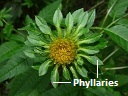
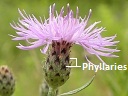
Phyllaries - bracts at the base of a composite (Aster family) flower head - also known as involucral
bracts - the picture at right shows phyllaries of Tall Beggar-ticks - the picture at far right shows the
phyllaries of Knapweed
bracts - the picture at right shows phyllaries of Tall Beggar-ticks - the picture at far right shows the
phyllaries of Knapweed
Cultivar - a 'cultivated variety" of a plant species that has been bred for desirable characteristics
such as flower colour or shape, crop yield or resistance to disease - genetically, a cultivar is not
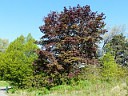
sufficiently different from its host to be defined as a new species - the picture at right shows the
'Crimson King' cultivar of the Norway Maple tree
such as flower colour or shape, crop yield or resistance to disease - genetically, a cultivar is not
sufficiently different from its host to be defined as a new species - the picture at right shows the
'Crimson King' cultivar of the Norway Maple tree
Ootheca - an egg mass with a protective outer covering - produced by certain insects (notably
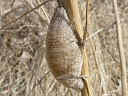
mantids and cockroaches) and mollusks - usually contains many eggs - the picture at right shows
the ootheca of a Praying Mantis
mantids and cockroaches) and mollusks - usually contains many eggs - the picture at right shows
the ootheca of a Praying Mantis

Autoecious - Rust fungus that can complete its life cycle on one host species - Heteroecious -
Rust fungus that requires two unrelated host species to complete its life cycle - there may be many
different potential hosts for a given species of Rust fungus - the picture at right shows the
Heteroecious Crown Oat Rust (hosts are Grass (barley, rye) and Buckthorn families) on its
alternate host European Buckthorn
Rust fungus that requires two unrelated host species to complete its life cycle - there may be many
different potential hosts for a given species of Rust fungus - the picture at right shows the
Heteroecious Crown Oat Rust (hosts are Grass (barley, rye) and Buckthorn families) on its
alternate host European Buckthorn
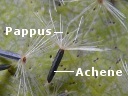
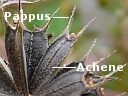
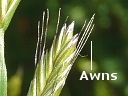
Achene - one-seeded fruit in plants of the Aster (Composite) family (and others) that is often
accompanied by a pappus - Pappus - modified calyx in plants of the Aster (Composite) family that
is composed of bristles, hairs, teeth or scales that aid in seed dispersal - the picture at right
shows the achene and pappus of White Snakeroot (seed dispersed by wind) - the picture at
middle right shows the achene and pappus of Tall Beggar-ticks (seed dispersed by attaching to
mammals or birds via two barbed teeth known as awns) - the picture at far right shows the awns of
Ryegrass
accompanied by a pappus - Pappus - modified calyx in plants of the Aster (Composite) family that
is composed of bristles, hairs, teeth or scales that aid in seed dispersal - the picture at right
shows the achene and pappus of White Snakeroot (seed dispersed by wind) - the picture at
middle right shows the achene and pappus of Tall Beggar-ticks (seed dispersed by attaching to
mammals or birds via two barbed teeth known as awns) - the picture at far right shows the awns of
Ryegrass
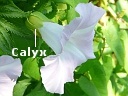
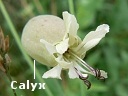
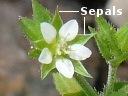
Calyx - the outer segment of a flower that encloses a flower bud - the individual parts of the calyx
are petal-like structures called sepals - sepals are often green but when they are similar to (and
the same colour as) the petals they are referred to as tepals - the picture at right shows the calyx of
Hedge Bindweed - the picture at middle right shows the bladder-like calyx of Bladder Campion -
the picture at far right shows the sepals of Thyme-leaved Sandwort
are petal-like structures called sepals - sepals are often green but when they are similar to (and
the same colour as) the petals they are referred to as tepals - the picture at right shows the calyx of
Hedge Bindweed - the picture at middle right shows the bladder-like calyx of Bladder Campion -
the picture at far right shows the sepals of Thyme-leaved Sandwort
Pappus - see achene
Heteroecious - see autoecious
Sepal - see calyx
Tepal - see calyx
Dioecious - see monoecious
Androecious - see monoecious
Gynoecious - see monoecious
Ovule - see pistil
Stamen, Staminate - see pistil
Anther - see pistil
Filament - see pistil
Carpellate - see pistil
Spadix - a dense spike of small flowers on a fleshy stalk that is associated with (and sometimes
enclosed by) a spathe - the fruiting spadix is a dense cluster of berries - Spathe - a large bract -
characteristic of the Arum family - the picture at right shows the spadix and spathe of
Jack-in-the-Pulpit ("Jack" is the spadix, "Pulpit" is the spathe) - the picture at far right shows the
fruiting spadix of Jack-in-the-Pulpit
enclosed by) a spathe - the fruiting spadix is a dense cluster of berries - Spathe - a large bract -
characteristic of the Arum family - the picture at right shows the spadix and spathe of
Jack-in-the-Pulpit ("Jack" is the spadix, "Pulpit" is the spathe) - the picture at far right shows the
fruiting spadix of Jack-in-the-Pulpit


Awn - see achene
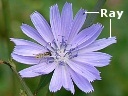
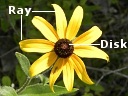
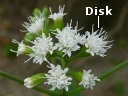
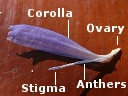
Composite - the Composite family (also known as Aster, Daisy or Sunflower family) is one of the
largest families of flowering plants - the flower head is not a single flower but a composite of many
disk and / or ray flowers (called florets or floscules) - the picture at top right shows Chicory which
only has ray florets - the picture at top far right shows White Snakeroot which only has disk florets -
the picture at bottom right shows Black-eyed Susan which has ray and disk florets - the picutre at
bottom far right shows a ray floret of Chicory containing both male and female parts - the ovary will
become an achene - 5 fused anthers form a tube around the style from which the stigma protrudes
- corolla consists of 5 fused petals
largest families of flowering plants - the flower head is not a single flower but a composite of many
disk and / or ray flowers (called florets or floscules) - the picture at top right shows Chicory which
only has ray florets - the picture at top far right shows White Snakeroot which only has disk florets -
the picture at bottom right shows Black-eyed Susan which has ray and disk florets - the picutre at
bottom far right shows a ray floret of Chicory containing both male and female parts - the ovary will
become an achene - 5 fused anthers form a tube around the style from which the stigma protrudes
- corolla consists of 5 fused petals
Floret, Floscule - see composite
Corolla - collective term for all the petals of a flower - the corolla and calyx are together called the
perianth
perianth
Perianth - see corolla
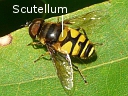
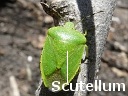
Scutellum - In zoology, the shield-like plate or scale on an insect thorax - typically a small triangle
at the base of the wings pointing to the tip of the abdomen - In botany, the shield-like structure of a
grass seed - the picture at right shows the scutellum of a Transverse Hover Fly - the picture at far
right shows the large scutellum of a Green Stink Bug
at the base of the wings pointing to the tip of the abdomen - In botany, the shield-like structure of a
grass seed - the picture at right shows the scutellum of a Transverse Hover Fly - the picture at far
right shows the large scutellum of a Green Stink Bug

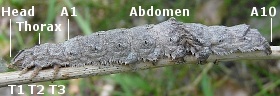
Thorax - the mid-section of an insect to which the head (first or anterior section), abdomen (third or
posterior section), legs and wings are attached - composed of three segments, the prothorax (T1),
mesothorax (T2) and metathorax (T3) - Abdomen - the posterior section of an insect consisting of a
number of segments (11 in most orders but reduced in others) and containing the digestive tract
and reproductive organs - the picture at right shows the head, thorax and abdomen (segments A1
to A10) of a White Tail dragonfly - the picture at far right shows the head, thorax (segments T1 to
T3) and abdomen (segments A1 to A10) of an Underwing Moth larva
posterior section), legs and wings are attached - composed of three segments, the prothorax (T1),
mesothorax (T2) and metathorax (T3) - Abdomen - the posterior section of an insect consisting of a
number of segments (11 in most orders but reduced in others) and containing the digestive tract
and reproductive organs - the picture at right shows the head, thorax and abdomen (segments A1
to A10) of a White Tail dragonfly - the picture at far right shows the head, thorax (segments T1 to
T3) and abdomen (segments A1 to A10) of an Underwing Moth larva
Hermaphrodite - see monoecious
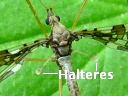
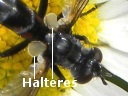
Haltere - also halter - modified wings of some insects that act as a gyroscope and help in
maintaining stability and executing high speed maneuvers during flight - in flies, the hindwings
have evolved into halteres while in some other species, the forewings have evolved - the picture at
right shows the halteres of a Band-winged Crane Fly - the picture at far right shows the halteres of
a Tachinid fly
maintaining stability and executing high speed maneuvers during flight - in flies, the hindwings
have evolved into halteres while in some other species, the forewings have evolved - the picture at
right shows the halteres of a Band-winged Crane Fly - the picture at far right shows the halteres of
a Tachinid fly
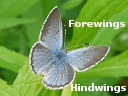
Prothorax - the 1st or anterior (T1) of 3 segments in the thorax of an insect - bears the first pair of
legs - mesothorax - the 2nd (T2) of 3 segments in the thorax of an insect - bears the 2nd pair of
legs and the forewings (when present) - metathorax - the 3rd or posterior (T3) of 3 segments in the
thorax of an insect - bears the 3rd pair of legs and the hindwings (when present) - the picture at
right shows the forewings and hindwings of a Silvery Blue Butterfly
legs - mesothorax - the 2nd (T2) of 3 segments in the thorax of an insect - bears the 2nd pair of
legs and the forewings (when present) - metathorax - the 3rd or posterior (T3) of 3 segments in the
thorax of an insect - bears the 3rd pair of legs and the hindwings (when present) - the picture at
right shows the forewings and hindwings of a Silvery Blue Butterfly
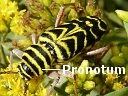
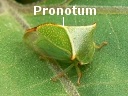
Pronotum - one of the main sclerites (exoskeletal plates) in the prothorax of an insect forming the
upper (dorsal) surface - in beetles and treehoppers, the pronotum is greatly exaggerated, aiding in
identification - the picture at right shows the pronotum of a Locust Borer Beetle - the picture at far
right shows the pronotum of a Buffalo Treehopper
upper (dorsal) surface - in beetles and treehoppers, the pronotum is greatly exaggerated, aiding in
identification - the picture at right shows the pronotum of a Locust Borer Beetle - the picture at far
right shows the pronotum of a Buffalo Treehopper
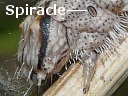
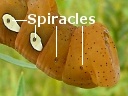
Spiracle - respiratory pore, especially those located along the sides of insects - the spiracles of a
caterpillar (Butterflies and Moths) appear on the 1st thoracic segment (T1) and the 1st through 8th
abdominal segments (A1 to A8) - the coloured area circling some spiracles often aids in
identification - the picture at right shows the T1 spiracle of an Underwing Moth larva - the picture at
far right shows the A1 to A4 spiracles of a Pandorus Sphinx Moth larva
caterpillar (Butterflies and Moths) appear on the 1st thoracic segment (T1) and the 1st through 8th
abdominal segments (A1 to A8) - the coloured area circling some spiracles often aids in
identification - the picture at right shows the T1 spiracle of an Underwing Moth larva - the picture at
far right shows the A1 to A4 spiracles of a Pandorus Sphinx Moth larva
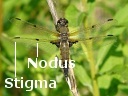
Stigma - in botany, see pistil - in zoology, a spiracle - also a coloured cell on the leading edge of
each wing in a dragonfly or damselfly and other insects (formerly pterostigma) - nodus - the
shallow notch at the midpoint of the leading edge of each wing in a dragonfly or damselfly - origin
of several veins that add strength and flexibility to the wing - the picture at right shows the stigma
and nodus of a 4-spotted Skimmer Dragonfly
each wing in a dragonfly or damselfly and other insects (formerly pterostigma) - nodus - the
shallow notch at the midpoint of the leading edge of each wing in a dragonfly or damselfly - origin
of several veins that add strength and flexibility to the wing - the picture at right shows the stigma
and nodus of a 4-spotted Skimmer Dragonfly
Style - see pistil
Nodus - see stigma
Median stripe (damselflies) - dark stripe that runs along the centre of the thorax, sometimes
bisected by the pale Middorsal stripe - Antehumeral stripe - pale stripe below the median stripe on
either side of the thorax - Humeral stripe - dark stripe below the antehumeral stripe on either side
of the thorax - additional stripes may be present below the humeral stripe - pattern on dragonflies
is more complex - Postocular spots - pale marks just below the eyes (not always present) - the
picture at right shows the median stripe and postocular spot of an Eastern Forktail Damselfly - the
picture at far right shows the stripes of a Slender Spriead-wing Damselfly
bisected by the pale Middorsal stripe - Antehumeral stripe - pale stripe below the median stripe on
either side of the thorax - Humeral stripe - dark stripe below the antehumeral stripe on either side
of the thorax - additional stripes may be present below the humeral stripe - pattern on dragonflies
is more complex - Postocular spots - pale marks just below the eyes (not always present) - the
picture at right shows the median stripe and postocular spot of an Eastern Forktail Damselfly - the
picture at far right shows the stripes of a Slender Spriead-wing Damselfly


Antehumeral stripe - see median stripe
Humeral stripe - see median stripe
Middorsal stripe - see median stripe
Postocular spot - see median stripe
Pterostigma - see stigma
Biennial - see annual
Perennial - see annual
Herbaceous plant - see annual
Woody plant - see annual
Umbel - see inflorescence
Capitulum - see inflorescence
Catkin - see inflorescence
Ament - see inflorescence
Corymb - see inflorescence
Cyme - see inflorescence
Head - see inflorescence
Panicle - see inflorescence
Raceme - see inflorescence
Spike - see inflorescence
Forb - see annual
Rachis - see peduncle
Pinna, Pinnule - see peduncle
Stipe - see peduncle
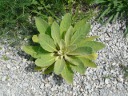
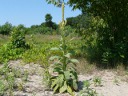
Annual / Biennial / Perennial - life cycle duration of a plant - an annual plant germinates, flowers and
dies in one year - a biennial plant takes two years to complete its life cycle - in the 1st year, it
produces only leaves low to the ground, often in a rosette - remains dormant over the winter and
flowers in the 2nd year - a perennial plant lives more than two years - herbaceous refers to small
flowering plants (annual, biennial or perennial) that have no persistent woody stem - forb refers to a
herbaceous plant that is not a graminoid (grasses, sedges, rushes) - woody plants are perennial
only, usually referring to shrubs and trees - the picture at right shows 1st year Common Mullein
(biennial) - the picture at far right shows 2nd year Common Mullein
dies in one year - a biennial plant takes two years to complete its life cycle - in the 1st year, it
produces only leaves low to the ground, often in a rosette - remains dormant over the winter and
flowers in the 2nd year - a perennial plant lives more than two years - herbaceous refers to small
flowering plants (annual, biennial or perennial) that have no persistent woody stem - forb refers to a
herbaceous plant that is not a graminoid (grasses, sedges, rushes) - woody plants are perennial
only, usually referring to shrubs and trees - the picture at right shows 1st year Common Mullein
(biennial) - the picture at far right shows 2nd year Common Mullein

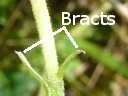
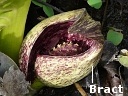
Bract - modified leaf that performs a specialized function such as attracting pollinators or
protecting young flowers - the picture at right shows the bracts of Field Bindweed - the picture at
middle right shows the bract (called a spathe in this case) of Skunk Cabbage - the picture at far
right shows the bracts of Wild Teasel
protecting young flowers - the picture at right shows the bracts of Field Bindweed - the picture at
middle right shows the bract (called a spathe in this case) of Skunk Cabbage - the picture at far
right shows the bracts of Wild Teasel
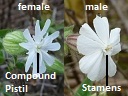
Monoecious - a plant that has male and female flowers (sometimes simultaneously, sometimes
at different times) - Dioecious - a plant that has only male (androecious - pollen / microspore
producers) or female (gynoecious - seed / megaspore producers) flowers - a hermaphrodite plant
(the majority of plants) has a flower with both male and female reproductive parts - the picture at
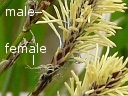
right shows the male and female flowers of Pennsylvania Sedge (monoecious) - the picture at
middle right shows the male and female flowers (on separate plants) of White Campion
(dioecious) - the picture at far right shows the pistil and stamens of Fringed Loosestrife
(hermaphrodite)
at different times) - Dioecious - a plant that has only male (androecious - pollen / microspore
producers) or female (gynoecious - seed / megaspore producers) flowers - a hermaphrodite plant
(the majority of plants) has a flower with both male and female reproductive parts - the picture at
right shows the male and female flowers of Pennsylvania Sedge (monoecious) - the picture at
middle right shows the male and female flowers (on separate plants) of White Campion
(dioecious) - the picture at far right shows the pistil and stamens of Fringed Loosestrife
(hermaphrodite)


Simple Leaf - a leaf composed of only 1 blade attached to a petiole (petiolated) or directly to the
stem (sessile) - Compound Leaf - a leaf composed of 2 or more leaf blades (pinnae or leaflets)
attached to a rachis (pinnately compound) or the tip of a petiole (palmately compound) - a pinnately
compound leaf may be odd pinnate (leaflet at tip) or even pinnate - a bi-pinnately compound leaf is
one where each leaflet is also pinnately compound - a trifoliate leaf is a palmately compound leaf
that has 3 leaflets - the picture at right shows the simple leaf of Velvet-leaf - the picture at middle
right shows the odd pinnately compound leaf of Staghorn Sumac - the picture at far right shows the
palmately compound (trifoliate) leaf of Red Clover
stem (sessile) - Compound Leaf - a leaf composed of 2 or more leaf blades (pinnae or leaflets)
attached to a rachis (pinnately compound) or the tip of a petiole (palmately compound) - a pinnately
compound leaf may be odd pinnate (leaflet at tip) or even pinnate - a bi-pinnately compound leaf is
one where each leaflet is also pinnately compound - a trifoliate leaf is a palmately compound leaf
that has 3 leaflets - the picture at right shows the simple leaf of Velvet-leaf - the picture at middle
right shows the odd pinnately compound leaf of Staghorn Sumac - the picture at far right shows the
palmately compound (trifoliate) leaf of Red Clover
Compound Leaf - see Simple Leaf
Pinnately Compound - see Simple Leaf
Palmately Compound - see Simple Leaf
Bi-pinnately Compound - see Simple Leaf
Trifoliate - see Simple Leaf
Prolegs - also known as false legs or pseudopods, the fleshy stubs found on the abdomen of
most butterfly, moth and sawfly larva as well as some fly larva - used for locomotion but unlike true
legs on the thorax of the larva which will become the legs of the adult, the prolegs have no
segments / joints and no counterpart in the adult - with few exceptions, sawfly larvae have 6 or
more pairs of prolegs while moth and butterfly larvae have up to 5 pairs - the picture at right shows
the true legs and the prolegs of a Zebra Caterpillar Moth larva
most butterfly, moth and sawfly larva as well as some fly larva - used for locomotion but unlike true
legs on the thorax of the larva which will become the legs of the adult, the prolegs have no
segments / joints and no counterpart in the adult - with few exceptions, sawfly larvae have 6 or
more pairs of prolegs while moth and butterfly larvae have up to 5 pairs - the picture at right shows
the true legs and the prolegs of a Zebra Caterpillar Moth larva

Native - plant that is found in the area where it evolved - Non-native - plant introduced to an area by
humans, intentionally or accidentally - Invasive - non-native plant which easily establishes itself
and spreads quickly causing economic or environmental damage - Naturalized - non-native plant
that does not need human assistance to reproduce - Exotic - plant that is not native to the continent
on which it is found - Weed - native or non-native plant that is not wanted where it is growing and
may pose a threat to the environment or to agriculture
humans, intentionally or accidentally - Invasive - non-native plant which easily establishes itself
and spreads quickly causing economic or environmental damage - Naturalized - non-native plant
that does not need human assistance to reproduce - Exotic - plant that is not native to the continent
on which it is found - Weed - native or non-native plant that is not wanted where it is growing and
may pose a threat to the environment or to agriculture
Non-native - see native
Naturalized - see native
Invasive - see native
Exotic - see native
Weed - see native
Forewing - see prothorax
Hindwing - see prothorax
Antemedial (AM) line - see median area
Antemedian (AM) area - see median area
Basal area - see median area
Postmedial (PM) line - see median area
Postmedian (PM) area - see median area
Subterminal (ST) line - see median area
Terminal line - see median area
Leaflet - see peduncle
Opposite - see alternate
Whorled - see alternate
MAD - see alternate
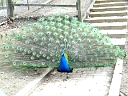
Dimorphism (sexual) - visual or behavioural difference between males and females of the same
species - male birds often have evolved ornamental plumage in competition over mates - female
birds however often have a drab appearance to provide camouflage while nesting - sometimes
these traits, being costly to produce or maintain, conspicuous or a hindrance in flight, are an
impediment to survival as in the Peacock at right - the picture at far right shows the visual
dimorphic traits of male and female Mallard Ducks
species - male birds often have evolved ornamental plumage in competition over mates - female
birds however often have a drab appearance to provide camouflage while nesting - sometimes
these traits, being costly to produce or maintain, conspicuous or a hindrance in flight, are an
impediment to survival as in the Peacock at right - the picture at far right shows the visual
dimorphic traits of male and female Mallard Ducks

Rhizome - in botany, a modified stem - usually horizontal and underground - often sends out roots
and shoots from nodes - each piece may be able to produce a new plant
and shoots from nodes - each piece may be able to produce a new plant
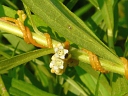
Symbiosis - a relationship between two or more organisms which can be one of four types:
Parasitism - a relationship where one organism is harmed and the other benefits -
Commensalism - a relationship where there is no harm or benefit to one organism but the other
benefits - Mutualism - a relationship where both organisms benefit - Amensalism - a relationship
where there is no harm or benefit to one organism but the other is harrmed - some say that
symbiosis only refers to mutualism - the picture at right shows the parasitic Dodder plant
Parasitism - a relationship where one organism is harmed and the other benefits -
Commensalism - a relationship where there is no harm or benefit to one organism but the other
benefits - Mutualism - a relationship where both organisms benefit - Amensalism - a relationship
where there is no harm or benefit to one organism but the other is harrmed - some say that
symbiosis only refers to mutualism - the picture at right shows the parasitic Dodder plant
Parasitism - see symbiosis
Commensalism - see symbiosis
Amensalism - see symbiosis
End of Page
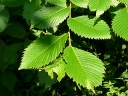
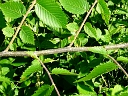
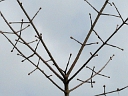
Alternate / Opposite - the arrangement of leaves or branches on a stem - alternate - each leaf (or
branch) arises from a different point on the stem on alternate sides - opposite - two leaves (or
branches) arise from the same point on the stem on opposite sides - an arrangement of leaves
may also be classified as whorled if several leaves originate (or appear to) from the same point on
a stem - the picture at right shows the alternate leaves of White Elm - the picture at middle right
shows the alternate branches of White Elm - the picture at far right shows the opposite branches
of European Euonymus - MAD is an acronym that can be used to describe most trees that have
oppostie branching (Maples, Ashes, Dogwoods)
branch) arises from a different point on the stem on alternate sides - opposite - two leaves (or
branches) arise from the same point on the stem on opposite sides - an arrangement of leaves
may also be classified as whorled if several leaves originate (or appear to) from the same point on
a stem - the picture at right shows the alternate leaves of White Elm - the picture at middle right
shows the alternate branches of White Elm - the picture at far right shows the opposite branches
of European Euonymus - MAD is an acronym that can be used to describe most trees that have
oppostie branching (Maples, Ashes, Dogwoods)
Thallus - a plant body that is not differentiated into stems and leaves - lacks true roots and a
vascular system - algae, fungi, lichens and some liverworts have thalli - the picture at right shows
the thallus of Snake Liverwort
vascular system - algae, fungi, lichens and some liverworts have thalli - the picture at right shows
the thallus of Snake Liverwort

Vascular - in plants, the system of conducting tissues and supporting fibres - xylem tissue
transports water and minerals from the roots to the leaves and the rest of the plant - phloem tissue
transports food (photosynthate - products of photosynthesis) from the leaves to the rest of the plant
- xylem tissue dies each year (forming the rings in tree trunks from which the age can be
determined) - phloem tissue lives as long as the plant or tree - Mosses, Liverworts, Hornworts and
Algae lack a vascular system
transports water and minerals from the roots to the leaves and the rest of the plant - phloem tissue
transports food (photosynthate - products of photosynthesis) from the leaves to the rest of the plant
- xylem tissue dies each year (forming the rings in tree trunks from which the age can be
determined) - phloem tissue lives as long as the plant or tree - Mosses, Liverworts, Hornworts and
Algae lack a vascular system
Photosynthesis - using chlorophyll, the process by which plants, some bacteria and some
protistans (single-celled organisms) convert light energy into chemical energy - carbohydrates
(sugars for example) are synthesized from carbon dioxide and water producing oxygen in the
process - responsible for maintaining oxygen levels in the atmosphere and supplying most of the
energy needed for life
protistans (single-celled organisms) convert light energy into chemical energy - carbohydrates
(sugars for example) are synthesized from carbon dioxide and water producing oxygen in the
process - responsible for maintaining oxygen levels in the atmosphere and supplying most of the
energy needed for life
Xylem - see vascular
Phloem - see vascular
Coniferous - cone-bearing tree or shrub usually with needles or scales for leaves which they
retain year round - most coniferous trees are referred to as softwoods or evergreens - Deciduous -
a tree or shrub whose leaves fall off yearly - most deciduous trees are referred to as hardwoods or
broadleaf - a conifer usually refers to a coniferous tree but a few species (tamaracks, larches and
Dawn Redwood for example) are known as deciduous conifers as their needles fall off yearly - a
coniferous tree photsynthesizes (at a slower rate than the broad leaves of deciduous trees) year
round and their needles lose less water and are more wind-resistant allowing them to survive in
harsher climates and poorer soil conditions compared to deciduous trees
retain year round - most coniferous trees are referred to as softwoods or evergreens - Deciduous -
a tree or shrub whose leaves fall off yearly - most deciduous trees are referred to as hardwoods or
broadleaf - a conifer usually refers to a coniferous tree but a few species (tamaracks, larches and
Dawn Redwood for example) are known as deciduous conifers as their needles fall off yearly - a
coniferous tree photsynthesizes (at a slower rate than the broad leaves of deciduous trees) year
round and their needles lose less water and are more wind-resistant allowing them to survive in
harsher climates and poorer soil conditions compared to deciduous trees
Chlorophyll - see photosynthesis
Evergreen - see coniferous
Hardwood - see coniferous
Softwood - see coniferous
Deciduous - see coniferous
Ovary - see pistil
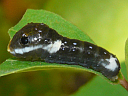
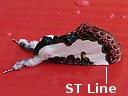
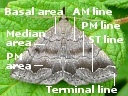
Median area - Moths - the central portion of the forewing - Basal (Antemedian or AM) area - the
area at the base of the forewing, often separated from the median area by the Antemedial (AM) line
- Postmedian (PM) area - the area in the outer third of the forewing, often bordered by the
Subterminal (ST) line and the Postmedial (PM) line - Terminal line - the outermost line on the
forewing - these parameters often aid in identifying noctuid moths (Owlet, Dart, Litter, Underwing) -
the picture at right shows these paramaters on a Black-banded Owlet Moth - the picture at far right
shows the ST line of a Pearly Wood Nymph Moth
area at the base of the forewing, often separated from the median area by the Antemedial (AM) line
- Postmedian (PM) area - the area in the outer third of the forewing, often bordered by the
Subterminal (ST) line and the Postmedial (PM) line - Terminal line - the outermost line on the
forewing - these parameters often aid in identifying noctuid moths (Owlet, Dart, Litter, Underwing) -
the picture at right shows these paramaters on a Black-banded Owlet Moth - the picture at far right
shows the ST line of a Pearly Wood Nymph Moth


Node - the positon on the stem where leaves, branches or flowers are attached - internode - the
region of the stem between nodes- sessile - leaf attached to the stem with no visible stalk -
petiolate - leaf attached to the stem by a stalk (petiole) - clasping - sessile leaf in which the base
partially or entirely surrounds the stem - perfoliate - sessile leaf in which the base is fused around
the stem and the stem appears to pierce the leaf - connate perfoliate - bases of opposite leaves
fused around the stem - sheathed - a tubular shaped portion of the leaf base surrounds the stem -
the pictures at right show the sessile leaf of Daisy Fleabane, the petiolate leaf of Velvet-leaf, the
clasping leaf of New England Aster, the perfoliate leaf of Bellwort, the connate perfoliate leaf of
Boneset and the sheathed leaf of Barnyard Grass
region of the stem between nodes- sessile - leaf attached to the stem with no visible stalk -
petiolate - leaf attached to the stem by a stalk (petiole) - clasping - sessile leaf in which the base
partially or entirely surrounds the stem - perfoliate - sessile leaf in which the base is fused around
the stem and the stem appears to pierce the leaf - connate perfoliate - bases of opposite leaves
fused around the stem - sheathed - a tubular shaped portion of the leaf base surrounds the stem -
the pictures at right show the sessile leaf of Daisy Fleabane, the petiolate leaf of Velvet-leaf, the
clasping leaf of New England Aster, the perfoliate leaf of Bellwort, the connate perfoliate leaf of
Boneset and the sheathed leaf of Barnyard Grass
Sessile - see node
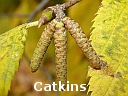
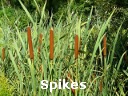
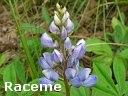
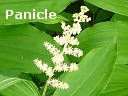
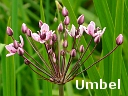
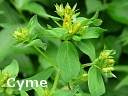
Inflorescence - cluster of flowers or groups of flowers - characterized by the arrangement of flowers
on the peduncle - solitary - only 1 flower on the peduncle - spike - group of sessile (no stalk)
flowers on the rachis - raceme - a spike but the flowers have pedicels - panicle - branched or
compound raceme where each branch has more than 1 flower - umbel - a flat-topped or rounded
raceme where individual flower stalks arise from a common center - characteristic of the Carrot
family - corymb - a raceme where individual flower stalks are of different lengths such that all
flowers are at the same level giving it a flat-topped appearance - head or capitulum - short dense
spike of flowers that appears to be a single flower - characteristic of the Aster family (see
composite) - cyme - a raceme in which the main axis and branches terminate in a single flower -
catkin or ament - a usually hanging spike, most of which are composed of unisexual flowers -
typically found on trees such as willows and cottonwoods - see also spadix for another type of
inflorescence - the pictures at right show the spike of Narrow-leaved Cattail, the raceme of
Wild Lupine, the panicle of False Solomon's Seal, the umbel of Flowering-rush, the cyme of
St. John's Wort and the catkins of Ironwood
on the peduncle - solitary - only 1 flower on the peduncle - spike - group of sessile (no stalk)
flowers on the rachis - raceme - a spike but the flowers have pedicels - panicle - branched or
compound raceme where each branch has more than 1 flower - umbel - a flat-topped or rounded
raceme where individual flower stalks arise from a common center - characteristic of the Carrot
family - corymb - a raceme where individual flower stalks are of different lengths such that all
flowers are at the same level giving it a flat-topped appearance - head or capitulum - short dense
spike of flowers that appears to be a single flower - characteristic of the Aster family (see
composite) - cyme - a raceme in which the main axis and branches terminate in a single flower -
catkin or ament - a usually hanging spike, most of which are composed of unisexual flowers -
typically found on trees such as willows and cottonwoods - see also spadix for another type of
inflorescence - the pictures at right show the spike of Narrow-leaved Cattail, the raceme of
Wild Lupine, the panicle of False Solomon's Seal, the umbel of Flowering-rush, the cyme of
St. John's Wort and the catkins of Ironwood
Internode - see node
Clasping - see node
Perfoliate - see node
Connate Perfoliate - see Node
Sheath - see node
Axil - upper angle between a plant stem and a leaf, branch or petiole - an axillary bud develops in
the axil of a leaf
the axil of a leaf
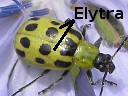
Elytra (singular Elytron) - modified, hardened forewings of certain insect orders, especially beetles
(Coleoptera) - primarily serve as protection for the more delicate hindwings which are used for
flying - in some ground beetles (Carabidae) and others the elytra are fused together making flight
impossible - the picture at right shows the elytra of the Spotted Cucumber Beetle
(Coleoptera) - primarily serve as protection for the more delicate hindwings which are used for
flying - in some ground beetles (Carabidae) and others the elytra are fused together making flight
impossible - the picture at right shows the elytra of the Spotted Cucumber Beetle

Exuvia - see instar


Larva (plural larvae) - see metamorphosis
Imago - see metamorphosis
Naiad - see metamorphosis
Nymph - see metamorphosis
Pupa - see metamorphosis
Chrysalis - see metamorphosis
Metathorax - see Prothorax
Mesothorax - see Prothorax

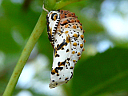
Metamorphosis - some insects, fish, amphibians, crustaceans and others undergo
metamorphosis, a process where an animal changes form during development (a tadpole
becomes a frog, a caterpillar becomes a butterflly) - some insects undergo complete
metamorphosis (egg to larva to pupa to imago / adult) in which the larva enters the nonfeeding
pupa stage (protective cocoon or hardened case) and undergoes a complete transformation - a
butterfly pupa is called a chrysalis - other insects undergo incomplete metamorphosis (egg to
nymph to imago / adult) where the nymph (usually resembling the adult without wings) goes
through stages of growth and moulting to become an adult - these stages are called instars
(larvae also go through these stages) - an aquatic nymph (dragonfly, stonefly and others) is called
a naiad - the top picture at right shows a Monarch larva - the top picture at centre shows a Monarch
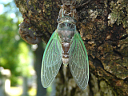
butterfly (complete metamorphosis) - the top picture at far right shows a recently moulted Cicada
imago / adult (incomplete metamorphosis) resting on its exuvia - the bottom picture at right shows
a Baltimore Checkerspot chrysalis (pupa) - the bottom picture at far right shows a damselfly naiad
metamorphosis, a process where an animal changes form during development (a tadpole
becomes a frog, a caterpillar becomes a butterflly) - some insects undergo complete
metamorphosis (egg to larva to pupa to imago / adult) in which the larva enters the nonfeeding
pupa stage (protective cocoon or hardened case) and undergoes a complete transformation - a
butterfly pupa is called a chrysalis - other insects undergo incomplete metamorphosis (egg to
nymph to imago / adult) where the nymph (usually resembling the adult without wings) goes
through stages of growth and moulting to become an adult - these stages are called instars
(larvae also go through these stages) - an aquatic nymph (dragonfly, stonefly and others) is called
a naiad - the top picture at right shows a Monarch larva - the top picture at centre shows a Monarch
butterfly (complete metamorphosis) - the top picture at far right shows a recently moulted Cicada
imago / adult (incomplete metamorphosis) resting on its exuvia - the bottom picture at right shows
a Baltimore Checkerspot chrysalis (pupa) - the bottom picture at far right shows a damselfly naiad
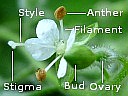
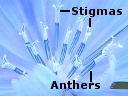
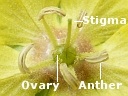
Pistil - the female part of a flower consists of the ovary (will become the fruit) and the stalk-like style
which supports the pollen receiving stigma - the ovary contains1 or more ovules which will
become the seeds after fertilization - Stamen - the male part of a flower consists of the stalk-like
filament which supports the pollen producing anther - the number, appearance and arrangement
of pistils and stamens varies - some flowers have only a pistil (carpellate or pistillate) or only a
stamen (staminate) - the picture at right shows the reproductive structure of Enchanter's
Nightshade - the picture at middle right shows the anthers and stigmas of Chicory - the picture at
far right shows the anthers and stigmas of Switch Grass
which supports the pollen receiving stigma - the ovary contains1 or more ovules which will
become the seeds after fertilization - Stamen - the male part of a flower consists of the stalk-like
filament which supports the pollen producing anther - the number, appearance and arrangement
of pistils and stamens varies - some flowers have only a pistil (carpellate or pistillate) or only a
stamen (staminate) - the picture at right shows the reproductive structure of Enchanter's
Nightshade - the picture at middle right shows the anthers and stigmas of Chicory - the picture at
far right shows the anthers and stigmas of Switch Grass

Slime Mould - group of amoeba-like single cell organisms which group together and fuse
exhibiting characteristics of fungi, plants and animals - there are 2 stages to a slime mould's life
cycle - the first (plasmodial) allows for movement and feeding - under adverse conditions (cold,
lack of food) the mould enters a second, immobile stage (sporangial) where it fruits and
reproduces via spores - the picture at right shows the sporangial stage of Chocolate Tube Slime
Mould - the middle and far right pictures show the plasmodial and sporangial stages of False
Puffball Slime Mould
exhibiting characteristics of fungi, plants and animals - there are 2 stages to a slime mould's life
cycle - the first (plasmodial) allows for movement and feeding - under adverse conditions (cold,
lack of food) the mould enters a second, immobile stage (sporangial) where it fruits and
reproduces via spores - the picture at right shows the sporangial stage of Chocolate Tube Slime
Mould - the middle and far right pictures show the plasmodial and sporangial stages of False
Puffball Slime Mould


Sporangium (plural sporangia) - see slime mould
Plasmodium (plural plasmodia) - see slime mould

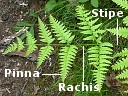
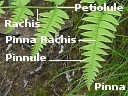
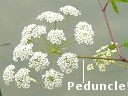
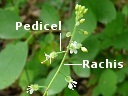
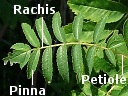
Peduncle - stalk bearing an inflorescence or a solitary flower (or fruit) on the main stem - Rachis -
central axis bearing a flower or flowers in an inflorescence (spike, raceme or panicle) or a pinna in
a fern blade or pinnately compound leaf - extension of the peduncle in the case of flowers, the
petiole in the case of a compound leaf or the stipe in the case of a fern - Pedicel - stalk bearing a
single flower in an inflorescence - Petiole - stalk that joins a simple or compound leaf blade to the
stem - Pinna (plural pinnae) - leaflet of a fern frond or a pinnately compound leaf - a leaf has a bud,
a pinna does not - Petiolule - stalk that joins a pinna to the rachis - Pinnule or Pinnula - leaflet of a
pinna in a fern frond or a bi-pinnately compound leaf - Stipe - stalk that joins a fern blade to the
stem - the picture at top right shows the peduncle of Spotted Water Hemlock - the picture at top
middle right shows the pedicel and rachis of an Enchanter's Nightshade raceme - the picture at
top far right shows the rachis, pinna and petiole of a pinnately compound Mountain Ash leaf - the
picture at bottom right shows the rachis, stipe and pinna of a Bracken Fern frond - the picture at
bottom far right shows a close-up of 3 pinnae of Bracken Fern
central axis bearing a flower or flowers in an inflorescence (spike, raceme or panicle) or a pinna in
a fern blade or pinnately compound leaf - extension of the peduncle in the case of flowers, the
petiole in the case of a compound leaf or the stipe in the case of a fern - Pedicel - stalk bearing a
single flower in an inflorescence - Petiole - stalk that joins a simple or compound leaf blade to the
stem - Pinna (plural pinnae) - leaflet of a fern frond or a pinnately compound leaf - a leaf has a bud,
a pinna does not - Petiolule - stalk that joins a pinna to the rachis - Pinnule or Pinnula - leaflet of a
pinna in a fern frond or a bi-pinnately compound leaf - Stipe - stalk that joins a fern blade to the
stem - the picture at top right shows the peduncle of Spotted Water Hemlock - the picture at top
middle right shows the pedicel and rachis of an Enchanter's Nightshade raceme - the picture at
top far right shows the rachis, pinna and petiole of a pinnately compound Mountain Ash leaf - the
picture at bottom right shows the rachis, stipe and pinna of a Bracken Fern frond - the picture at
bottom far right shows a close-up of 3 pinnae of Bracken Fern
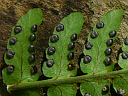
Sorus (plural sori) - cluster of sporangia (structures producing and containing spores) used in
reproduction for ferns, fungi and lichens - on ferns sori occur on fertile fronds only and they turn
from green to brown as they mature - for sporangia, see also slime mould - the picture at right
shows the sori of Bulblet Fern - the picture at far right shows the sori of Marginal Wood Fern
reproduction for ferns, fungi and lichens - on ferns sori occur on fertile fronds only and they turn
from green to brown as they mature - for sporangia, see also slime mould - the picture at right
shows the sori of Bulblet Fern - the picture at far right shows the sori of Marginal Wood Fern
Petiole, Petiolule - see peduncle
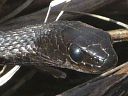
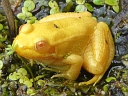
Melanistic - an excessive production of melanin (skin or hair pigment) resulting in a dark colour -
Amelanistic - a lack of melanin (albino) - the picture at right shows a melanistic Garter Snake - the
picture at far right shows an amelanistic Green Frog
Amelanistic - a lack of melanin (albino) - the picture at right shows a melanistic Garter Snake - the
picture at far right shows an amelanistic Green Frog
Amelanistic - see melanistic
Antenna (plural antennae) - jointed sensory appendages attached to the head of arthropods - most
arthropods have 1 pair of antennae (spiders have none, crustaceans have 2 pairs) - most notably
used to provide a sense of smell but may also provide information on touch, sound (vibration),
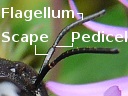
humidity, air motion or heat - consists of 3 parts: Scape (basal segment controls movement),
Pedicel (controls movement and contains sense organs) and Flagellum (1 to more than 30
structures known as flagellomeres containing sense organs) - the scape, pedicel and
flagellomeres are collectively known as antennomeres - in bees, the male has 11 flagellomeres
and the female has 10 - the picture at right shows the antennae of a Common Carpenter Bee
arthropods have 1 pair of antennae (spiders have none, crustaceans have 2 pairs) - most notably
used to provide a sense of smell but may also provide information on touch, sound (vibration),
humidity, air motion or heat - consists of 3 parts: Scape (basal segment controls movement),
Pedicel (controls movement and contains sense organs) and Flagellum (1 to more than 30
structures known as flagellomeres containing sense organs) - the scape, pedicel and
flagellomeres are collectively known as antennomeres - in bees, the male has 11 flagellomeres
and the female has 10 - the picture at right shows the antennae of a Common Carpenter Bee
Antennomere - see antenna
Flagellum, Flagellomere - see antenna
Parthenogenesis - asexual reproduction where the growth and development of an embryo
occurs without fertilization
occurs without fertilization
Scape - see antenna
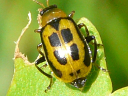
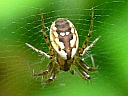
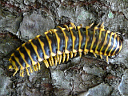
Arthropod - invertebrate (having no spine) animal with an exoskeleton (external skeleton), a
segmented body and jointed appendages - includes insects, spiders, centipedes, millipedes and
crustaceans - the pictures at right show an insect (Bean Leaf Beetle), a spider (Tuftlegged
Orbweaver) and a Flat-backed Millipede
segmented body and jointed appendages - includes insects, spiders, centipedes, millipedes and
crustaceans - the pictures at right show an insect (Bean Leaf Beetle), a spider (Tuftlegged
Orbweaver) and a Flat-backed Millipede
Instar - stage in the life of the larva, nymph or pupa of arthropods where they moult to shed their
exoskeleton allowing them to grow - the period between each moult is known as an instar -
successive instars are often characterized by a different form, pattern, colour or number of
segments - the number of instars for a given organism depends on the species and
environmental conditions - exuvia - remains of the exoskeleton that is left after moulting - the
picture at right shows an early instar of a Spicebush Swallowtail larva - the picture at far right
shows a Cicada nymph
exoskeleton allowing them to grow - the period between each moult is known as an instar -
successive instars are often characterized by a different form, pattern, colour or number of
segments - the number of instars for a given organism depends on the species and
environmental conditions - exuvia - remains of the exoskeleton that is left after moulting - the
picture at right shows an early instar of a Spicebush Swallowtail larva - the picture at far right
shows a Cicada nymph
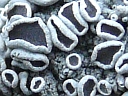
Lichen - mutualistic association of a fungus and a photosynthesising partner (alga or
cyanobacterium) - the fungal component may not be able to survive on its own - the Lichen takes
its binomial name (genus:species) from that of the fungus - most of the fungal components
belong to the Sac fungi (Ascomycota) division - many lichens are sensitive to pollution and will not
be present where air quality is poor - the picture at right shows a Physcia species lichen
cyanobacterium) - the fungal component may not be able to survive on its own - the Lichen takes
its binomial name (genus:species) from that of the fungus - most of the fungal components
belong to the Sac fungi (Ascomycota) division - many lichens are sensitive to pollution and will not
be present where air quality is poor - the picture at right shows a Physcia species lichen
Drake - male duck
Eclipse - Dull coloured female-like plumage of male ducks (drakes) into which they moult after
breeding - for a brief period they are unable to fly as the flight feathers are lost and renewed - some
drakes remain in eclipse for a month or two while others retain their eclipse plumage until spring
when there is a further moult to enter breeding plumage - the flight feathers are not affected during
this moult - most non-waterfowl birds lose their flight feathers sequentially during a moult so that
they retain the ability to fly
breeding - for a brief period they are unable to fly as the flight feathers are lost and renewed - some
drakes remain in eclipse for a month or two while others retain their eclipse plumage until spring
when there is a further moult to enter breeding plumage - the flight feathers are not affected during
this moult - most non-waterfowl birds lose their flight feathers sequentially during a moult so that
they retain the ability to fly


Subreniform spot - see reniform spot
Orbicular spot - see reniform spot
Reniform spot - usually kidney-shaped spot or outline in the outer median area of a moth's
forewing - Subreniform spot - small spot or outline between the Reniform spot and the inner edge
of a moth's forewing - Orbicular spot - round spot or outline in the inner median area of a moth's
forewing - these parameters often aid in identifying noctuid moths (Owlet, Dart, Litter, Underwing) -
the picutre at right shows the Reniform and Subreniform spots of an Ilia Underwing moth - the
picture at far right shows the Reniform and Orbicular spots of a Grote's Sallow moth
forewing - Subreniform spot - small spot or outline between the Reniform spot and the inner edge
of a moth's forewing - Orbicular spot - round spot or outline in the inner median area of a moth's
forewing - these parameters often aid in identifying noctuid moths (Owlet, Dart, Litter, Underwing) -
the picutre at right shows the Reniform and Subreniform spots of an Ilia Underwing moth - the
picture at far right shows the Reniform and Orbicular spots of a Grote's Sallow moth
Teneral - a teneral insect is one that has recently moulted or emerged from the pupa and has a
soft exoskeleton and pale colouration - it may be able to fly with difficulty but until its exoskeleton
and wings have hardened it is in a vulnerable state
soft exoskeleton and pale colouration - it may be able to fly with difficulty but until its exoskeleton
and wings have hardened it is in a vulnerable state
Eclosure / Eclosion - in biology, the emergence of an adult insect from the pupa or a larva from an
egg - verb eclose
egg - verb eclose
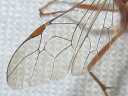
Areolet - For insects, a small area on the wings enclosed by veins - the picture at right shows the
aerolets of an Ophion Ichneumon Wasp
aerolets of an Ophion Ichneumon Wasp
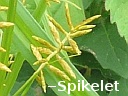
Spikelet - part of the inflorescence of a grass or sedge - the picture at right shows the spikelets of
a Yellow Nutsedge inflorescence
a Yellow Nutsedge inflorescence
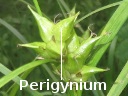
Perigynium (plural perigynia) - in sedges, a sac-like structure that encloses the achene - the
picture at right shows the perigynia of Bladder Sedge
picture at right shows the perigynia of Bladder Sedge